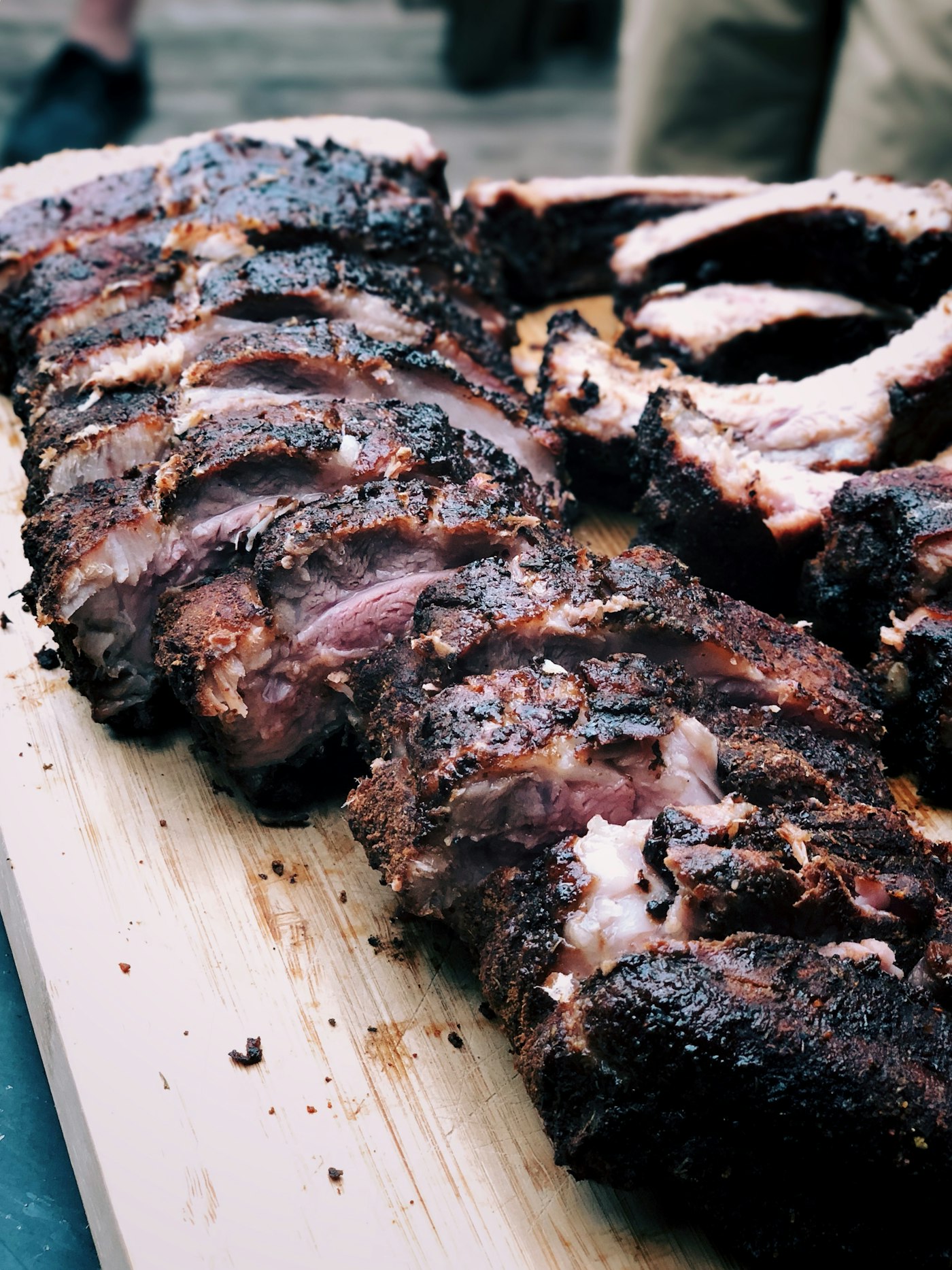
Real Texas brisket is an exercise in restraint. No sauce, no complicated rub — just a whole packer brisket, coarse salt, black pepper, oak smoke, and time. Twelve hours of smoke at 225°F, wrapped in butcher paper at the stall, rested two hours before slicing. There is no shortcut and no substitute. The result is a thick smoke ring, bark you can crack with a finger, and slices that bend without breaking.
The Cut & Prep
Trim the fat cap to a consistent 6mm. Any thicker and it won't render; any thinner and you lose the baste. Remove hard fat deposits from the deckle — they won't render. Season aggressively on all sides, including the sides. Let rest uncovered in the fridge overnight — the salt draws moisture out and back in, seasoning deep into the meat.
The Smoke
- Bring smoker to a stable 225–250°F (107–121°C) with a clean smoke fire
- Place brisket fat-side up, point toward the heat source
- Maintain temperature — big swings are the enemy of even cooking
- The stall hits around 155–165°F internal — this is water evaporating, not the meat stopping. Do not panic. Do not raise the temperature.
- At the stall, wrap tightly in uncoated butcher paper (not foil — paper allows vapor to escape, foil creates steam and softens the bark)
- Return to the smoker. Target 203°F (95°C) internal temperature
- Total cook time: 1 to 1.5 hours per kilo at 225°F
"Probe tender is more important than any temperature number. At 203°F, insert a probe or skewer into the thickest part of the flat — it should slide in with the resistance of soft butter. If there is any resistance, it needs more time."
The Rest — Non-Negotiable
Wrap in a second layer of butcher paper and rest in a cooler (no ice) for a minimum of 2 hours. During the rest, the muscle fibers relax and reabsorb the juices that were driven out during cooking. A brisket sliced immediately after coming off the smoker will be dry. The same brisket after a 2-hour rest will be juicy.
Slice the flat against the grain at 8–10mm thickness — slices should bend 45° without breaking. The point can be cubed into "burnt ends" for the best bite in barbecue.
The pink smoke ring is a chemical reaction between myoglobin and nitric oxide from the combustion. It stops forming at around 140°F — so the longer the brisket is in smoke below that temperature, the deeper the ring. It is cosmetic, not a flavor indicator, but a good smoke ring suggests patient, low-temperature cooking — exactly what you want.