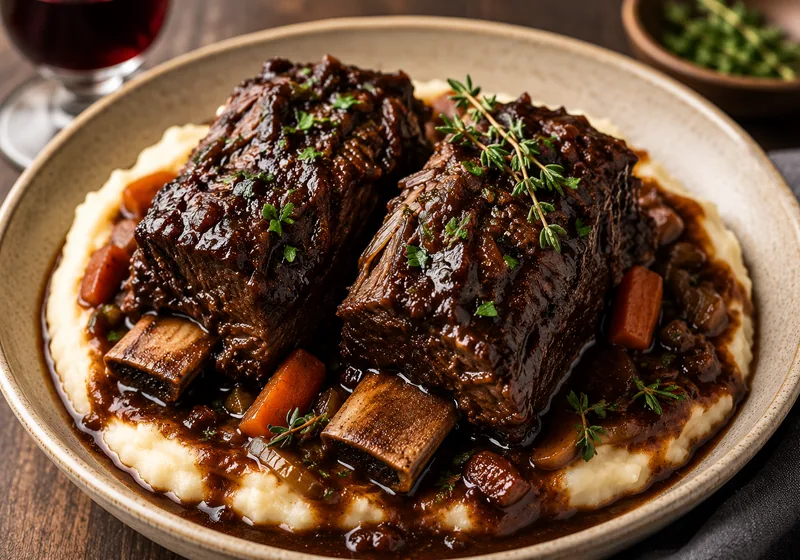
Short ribs are built for braising. What starts as one of the toughest cuts on the animal — packed with dense collagen and thick connective tissue — becomes impossibly tender after three hours in a Bordeaux reduction. The braising liquid concentrates into a glossy, deep sauce that needs nothing added to it. This is Sunday cooking at its finest, and it is always better the next day.
The Marinade — Night Before
Combine wine, vegetables, and aromatics in a large container. Add the ribs and submerge completely. Cover and refrigerate overnight — minimum 8 hours, ideally 16. The wine begins breaking down the connective tissue and penetrates the meat deeply. This step is not optional: it is about texture as much as flavor.
The Braise
Remove the ribs from the marinade and pat completely dry — wet meat steams instead of searing. Strain and reserve the marinade liquid. Season the ribs aggressively with salt and pepper on all sides.
In a Dutch oven over the highest heat, sear the ribs in batches — never crowd the pot. Each side needs 3 full minutes of undisturbed contact to build the deep mahogany crust that will give the sauce its color and body. A pale sear is wasted effort.
- Remove seared ribs. Discard most of the fat, leaving about 1 tbsp in the pot
- Fry the strained vegetables from the marinade for 5 minutes until slightly caramelized
- Add tomato paste, cook 2 minutes until it darkens and sticks to the bottom
- Pour in the reserved marinade wine, scrape up every bit of fond from the bottom
- Reduce the wine by half — this cooks off harsh tannins and concentrates flavor
- Add veal stock, return the ribs — they should be at least 75% submerged
- Bring to a simmer, cover tightly, transfer to oven at 160°C (325°F)
Braise for 2h30 to 3 hours. The ribs are ready when a fork slides in with zero resistance and the meat pulls slightly away from the bone.
The Sauce
Remove ribs carefully — they are fragile at this point. Strain the braising liquid through a fine-mesh sieve, pressing the softened vegetables to extract every drop. Skim the fat from the surface. Reduce the strained liquid over medium heat until it coats the back of a spoon and shows a slight shine. Taste and adjust salt. Do not add anything — this sauce is already complete.
"The braising liquid is the recipe. Every hour of cooking, every vegetable, every bit of fond — it all lives in that sauce. Reduce it with respect."
Serve over creamy celeriac purée, buttered polenta, or crushed potatoes — something starchy and neutral that absorbs the sauce. A gremolata of lemon zest, flat-leaf parsley, and raw garlic adds brightness that cuts through the richness in a way nothing else does. A few flakes of fleur de sel over the meat just before serving.
This dish improves significantly when made a full day ahead. Refrigerate the ribs in their sauce overnight. The fat lifts off cleanly as a solid layer, the flavors deepen, and the collagen sets the sauce into a loose gel. Reheat gently covered at 150°C for 30 minutes. The meat will not dry out.