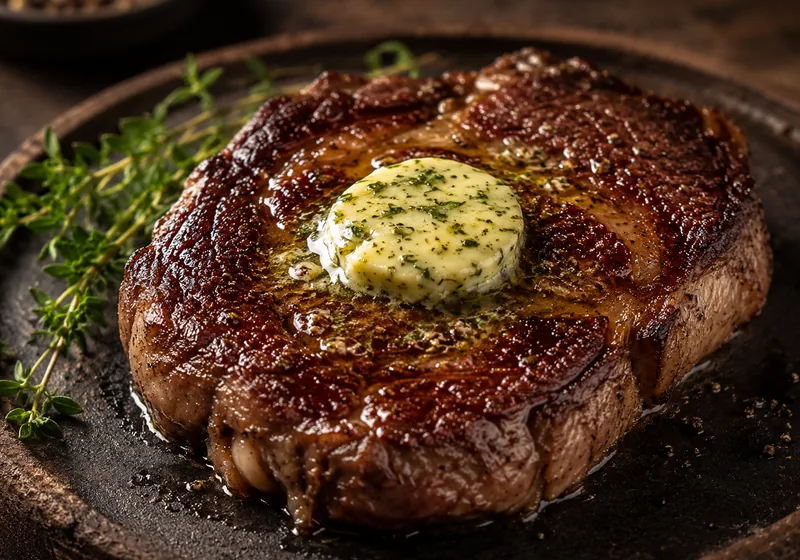
The café de Paris butter is one of the great secrets of Swiss-French cooking — born in Geneva, perfected by obsessives. A compound butter layered with 15+ aromatics: anchovies, capers, Dijon, curry, marjoram, lemon zest. It melts slowly over a cast-iron-seared ribeye and becomes the sauce. No reduction, no pan work — just heat, butter, and perfect timing.
The Café de Paris Butter
Make this the night before — or at least 2 hours ahead. The flavors need time to meld. Left overnight, this butter becomes something entirely different from what it was when first mixed.
In a bowl, work all ingredients into the softened butter with a fork or spatula until completely homogeneous. Taste — it should be intensely savory, complex, and slightly acidic. Adjust salt (anchovies and capers are already salty — go carefully). Turn onto a sheet of cling film, roll into a tight log about 4cm diameter, twist the ends to seal. Refrigerate overnight. The butter keeps for 10 days in the fridge or 3 months frozen.
The Steak
The Sear
Remove steaks from the fridge 1 full hour before cooking — a cold center is the enemy of even doneness. Pat every surface completely dry with paper towels. Season generously with fleur de sel on all sides including the fat cap. No pepper yet — it burns at searing temperatures.
Heat a cast iron skillet over the highest flame you have for at least 3 minutes. It should be just starting to smoke. Oil the steaks directly, not the pan — this gives better Maillard contact.
- Lay steaks away from you into the pan — no sizzle means the pan is not hot enough
- Sear 3 minutes on the first side — do not move, do not press, do not touch
- Flip once, sear 2.5 minutes on the second side
- Using tongs, stand each steak upright on its fat cap for 90 seconds — the fat renders and bastes the sides
- Lay flat again, add the knob of plain butter, thyme, and smashed garlic
- Tilt the pan slightly and baste continuously for 60 to 90 seconds
"The crust is built in the first 30 seconds. After that, you're just adding time. If it's not deep brown when you flip, your pan wasn't hot enough — there is no recovery."
Rest & Finish
Transfer steaks to a warm plate (rinse it with hot water and dry it first). Rest for 5 to 6 minutes — same duration as the total cook time. Do not tent with foil; it creates steam and softens the crust you just built. Add freshly cracked black pepper now, while the surface is still hot.
While the steak rests, slice two generous rounds of café de Paris butter (about 1cm thick each) from the log. Lay them directly on top of the hot steak just before serving — by the time the plate reaches the table, the butter should be half-melted, streaming down the sides into a puddle of aromatic, herby sauce.
Rare: 50°C (122°F) — pull at 48°C. Medium-rare: 55°C (131°F) — pull at 52°C. Medium: 60°C (140°F) — pull at 57°C. Carryover cooking during the rest adds 3–4°F. Always pull early. A thermometer is not optional — it is the only tool that tells the truth.
Ribeye is the right choice here because its generous fat marbling provides constant self-basting during the sear. A minimum of 3cm thickness is non-negotiable — anything thinner overcooks before the crust develops. For a special occasion, ask your butcher for a bone-in cowboy cut: same muscle, more drama, better flavor around the bone.