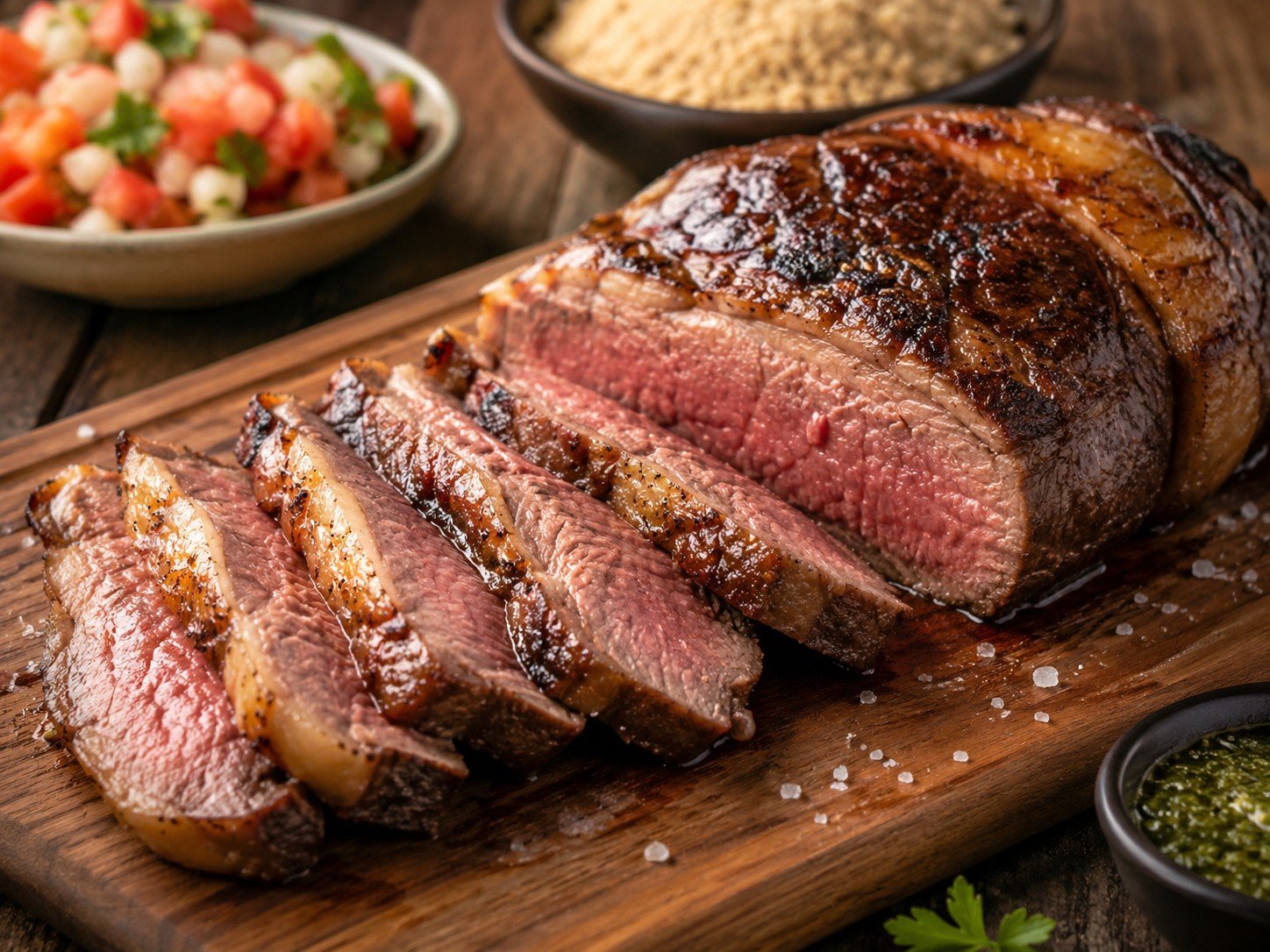
In Brazil, the picanha is not just a cut of beef — it is a cultural institution. At any churrascaria worth its salt, the picanha arrives at the table on a curved skewer, its fat cap glistening and caramelized, sliced tableside into thick pieces that hit the plate already resting and perfectly medium-rare. It is simple food executed with total conviction. No marinades, no complex rubs. Just a magnificent piece of rump cap, coarse salt, high heat, and the knowledge of exactly when to pull it off the fire.
Outside Brazil, picanha is sometimes sold as rump cap, coulotte steak, or sirloin cap. It sits at the top of the rump, covered by a substantial fat cap that is both its defining feature and its biggest advantage. That fat melts and bastes the meat throughout cooking, creating a flavor and richness that cannot be achieved any other way. Under no circumstances should you trim it before cooking.
Ingredients
Understanding the cut
The picanha is a triangular muscle that sits above the rump, attached by a thick layer of fat — typically 1 to 2cm thick. The muscle itself is relatively tender and fine-grained, with moderate marbling. What makes it extraordinary is that combination of lean, flavorful meat and abundant external fat. When cooked properly, the fat renders and crisps on the outside while the meat inside remains juicy and deeply beefy. It has a pronounced savory flavor, more intense than sirloin, less aggressive than ribeye.
A whole picanha weighs between 1 and 1.5kg. Anything larger is likely a different muscle attached at the butcher's discretion. If the piece you are buying weighs 2kg or more, ask your butcher to clarify which part is the actual picanha. The authentic cut is always smaller and more triangular.
The Brazilian method: grill
Score the fat cap in a crosshatch pattern, cutting just through the fat without reaching the meat. This allows even rendering and prevents the fat from buckling on the grill. Let the picanha sit at room temperature for a full hour — cold center meat cooks unevenly. Season the fat cap very generously with coarse salt, pressing it into the score marks. Season the flesh side more moderately.
The traditional Brazilian approach is to fold the picanha in a C-shape on a curved skewer (fat cap facing outward) and cook it over charcoal. At home, the simplest equivalent is a very hot charcoal or gas grill. Place the picanha fat-side down over high heat for 5 to 6 minutes until the fat is golden and rendered. Flip and cook 4 to 5 minutes per side to medium-rare, targeting an internal temperature of 52°C. Let rest 10 minutes on a rack before slicing against the grain.
The home method: cast iron
If you do not have a grill, a cast iron skillet gives excellent results. Heat it until smoking. Place the picanha fat-side down, weight it with a heavy pan or press, and cook 6 minutes — you want the fat to render and form a proper crust. Then sear the two remaining sides, 3 to 4 minutes each. Finish in a 200°C oven for 8 minutes if the piece is thick. Rest 10 minutes before slicing.
Slicing and serving
Always slice against the grain into pieces at least 1cm thick. Thinner slices lose the texture advantage of the cut. Serve with fleur de sel on the side — a few extra flakes on each slice just before eating make a significant difference. In Brazil, picanha is traditionally accompanied by farofa (toasted cassava flour), vinaigrette (tomato, onion, olive oil, and vinegar), and white rice. A simple chimichurri or fresh herb vinaigrette also works beautifully.
Temperature guide
Picanha is best served medium-rare to medium. The muscle is relatively lean in its interior, and overcooking makes it noticeably tougher. Pull at 52°C for medium-rare (rises to 55°C while resting) or 57°C for medium. Well-done picanha is edible but not the intended experience. Use a thermometer — this is not the cut to guess on.