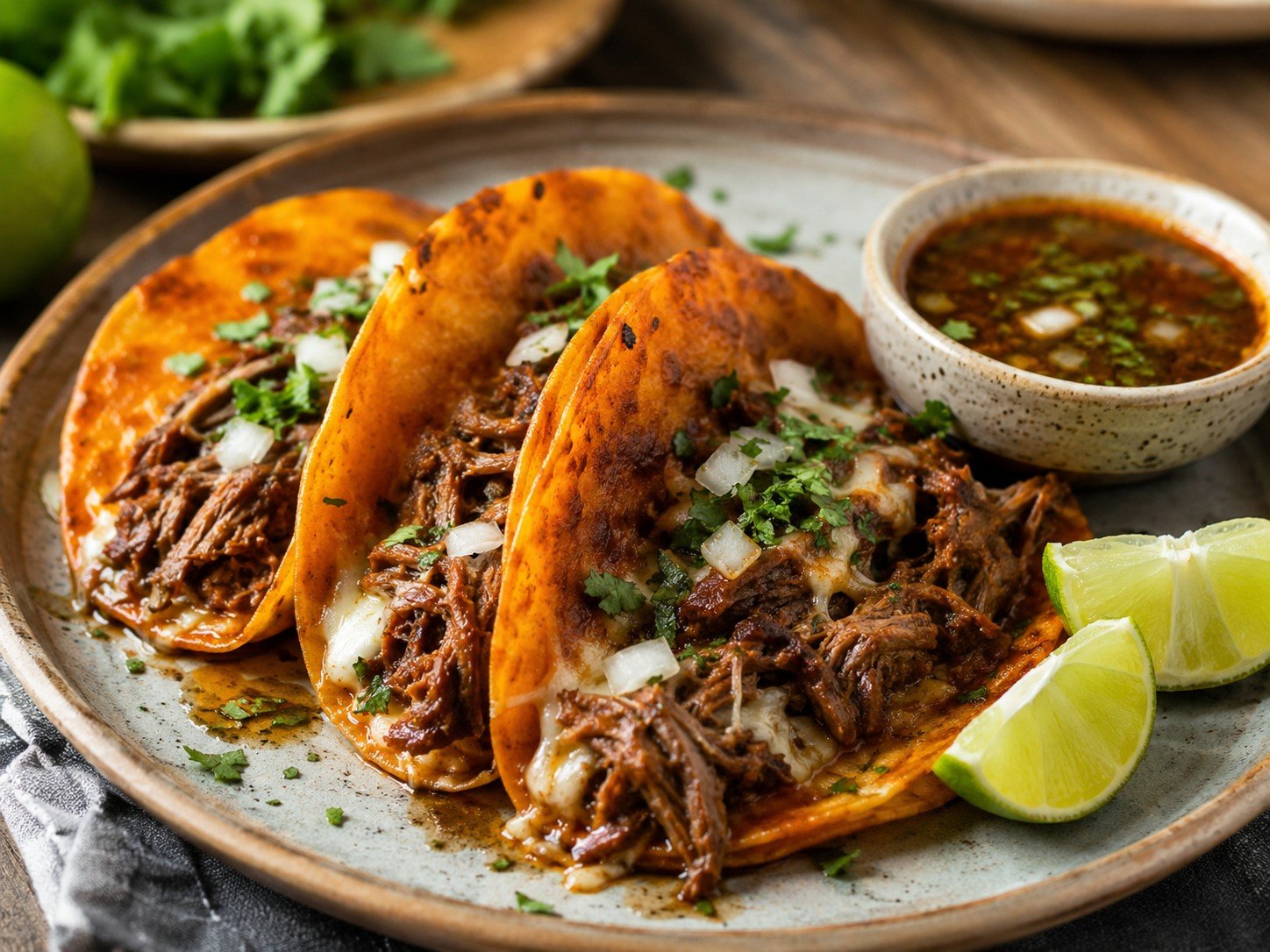
Birria started in Jalisco as a goat stew served at weddings and celebrations — a dish built for feeding crowds, for slow Sundays, for the kind of cooking that fills the whole house with the smell of toasted chiles and dark braising liquid. Then someone dipped a corn tortilla in the braising consommé, pressed it against a hot griddle, and everything changed. The quesabirria — a crispy, red-stained, cheese-filled taco dipped in rich chile broth — became one of the most viral food moments of the past decade. For entirely valid reasons.
Birria is not a quick recipe. It is a project. But it is also largely hands-off: the oven does the work, the beef becomes impossibly tender, and the consommé — that deep, complex braising liquid — rewards the patience you put in. Make a large batch on a Saturday afternoon and you will eat extraordinarily well for the rest of the weekend.
The chile base
The three-chile combination is deliberate. Guajillo chiles bring a sharp, bright heat and deep red color. Ancho — dried poblano — adds earthy, raisin-like sweetness and body. Pasilla gives a dark, slightly smoky bass note. Together, they build a chile sauce that is complex without being one-dimensional. If you can only find guajillo and ancho at your local Latin grocery, that combination works well too.
The beef
Chuck is the ideal cut for birria. It has enough intramuscular fat and connective tissue to break down beautifully over three hours of low heat, turning from tough and chewy to silky and pullable. Short rib is optional but adds richness and that fall-off-the-bone gelatinous quality that makes the consommé extraordinary. The warm spices — cinnamon, cloves — may seem unusual but they are traditional, adding depth without tasting like a dessert.
For the tacos
Toast the chiles
In a dry skillet over medium heat, toast each dried chile for 30 seconds per side — just until fragrant, not burnt. The moment they begin to smell like chocolate and spice is the right moment. Place in a bowl and cover with boiling water. Soak 20 minutes until completely soft. Meanwhile, char the tomatoes, onion halves, and unpeeled garlic in the same pan until blackened in spots. This charring adds depth and a subtle smokiness that no amount of seasoning can replicate later.
Build the adobo
Drain the chiles, discarding the soaking water (it can be bitter). Blend with the charred vegetables, vinegar, cumin, oregano, cinnamon, cloves, and 250ml fresh water until completely smooth. Pass through a fine sieve to remove skins and seeds. What you are left with is your adobo — a dark, intensely flavored paste that will become both the braising liquid and the base of your consommé.
Braise the beef
Season beef generously with salt and pepper. In a large Dutch oven over high heat, sear all sides until deeply browned, 3 to 4 minutes per side. Do not rush this — the crust is flavor that carries into the finished dish. Pour the adobo over the beef, add enough water to cover (about 500ml), and bring to a boil. Reduce to low, cover, and braise for 3 hours until the beef falls apart at the touch of a fork. Remove beef and shred with two forks. Reserve every drop of the consommé.
Assemble the quesabirria
Skim fat from the consommé surface and collect it in a small bowl. This rendered fat is your secret weapon. Dip a tortilla in the fat (not the consommé itself), then place on a hot griddle over medium-high heat. Add shredded birria and cheese. Fold in half. Cook 2 to 3 minutes per side until the tortilla is crispy and brick-red, the cheese molten. Serve immediately with a bowl of hot consommé alongside for dipping, topped with diced onion and fresh cilantro. Squeeze lime over everything.
Make-ahead and storage
Birria is even better the next day. The braised beef and consommé keep refrigerated for up to 4 days, and the fat that solidifies on top of the consommé is easy to skim. The shredded beef freezes beautifully for up to 3 months. Reheat both gently before assembling tacos. Leftover birria beef is also excellent folded into scrambled eggs, stuffed into a quesadilla, or served over rice with the consommé poured on top like a gravy.