Duck Leg Confit — GetNeatMeat

Also Try

Gochujang Pork Ribs
Pork · Korean

Gochujang Pork Ribs

Birria Beef Tacos
Beef · Mexican

Birria Beef Tacos

, slow-cooked submerged in duck fat for 3 hours, then crisped in a screaming-hot pan. The definitive guide to confit de canard."meta{"@context":"https://schema.org","@type":"Recipe","name":"Duck Leg Confit","description":"Classic French duck leg confit","image":["https://getneatmeat.com/images/duck-leg-confit.jpg"],"author":{"@type":"Organization","name":"GetNeatMeat"},"publisher":{"@type":"Organization","name":"GetNeatMeat","url":"https://getneatmeat.com"},"url":"https://getneatmeat.com/recipe/duck-leg-confit/","datePublished":"2026-06-27","prepTime":"PT20M","cookTime":"PT3H","totalTime":"PT27H","recipeYield":"2 servings","recipeCategory":"Main Course","recipeCuisine":"French","keywords":"duck confit, confit de canard, duck leg, French cooking","recipeIngredient":["2 duck legs (about 350g each)","15g coarse salt","4 garlic cloves, smashed","4 sprigs fresh thyme","2 bay leaves, crumbled","1 tsp black peppercorns, cracked","500-700g duck fat"],"recipeInstructions":[{"@type":"HowToStep","name":"Cure","text":"Rub duck legs with salt, garlic, thyme, bay leaf and peppercorns. Refrigerate 12-24 hours."},{"@type":"HowToStep","name":"Cook in fat","text":"Rinse and dry legs. Submerge in duck fat, cook at 90C for 3 hours."},{"@type":"HowToStep","name":"Crisp","text":"Pat dry, place skin-side down in hot dry skillet. Cook 4-5 minutes until skin is golden and crackling."}],"nutrition":{"@type":"NutritionInformation","calories":"680 calories","proteinContent":"42g","fatContent":"55g","carbohydrateContent":"0g"}}:root{--black:#0a0a0a;--dark:#111111;--dark-2:#1a1a1a;--border:rgba(255,255,255,.08);--border-2:rgba(255,255,255,.14);--ember:#c8502a;--gold:#c9963a;--cream:#f5ede0;--white:#ffffff;--muted:rgba(255,255,255,.45);--muted-2:rgba(255,255,255,.65);--disp:"Playfair Display",Georgia,serif;--body:"Inter",sans-serif;--mono:"DM Mono",monospace;--wrap:1200px;--radius:4px}*,*:before,*:after{margin:0;padding:0;box-sizing:border-box}body{font-family:var(--body);background:var(--black);color:var(--white);font-size:16px;line-height:1.7;-webkit-font-smoothing:antialiased}img{max-width:100%;display:block}a{color:inherit;text-decoration:none}h1,h2,h3{font-family:var(--disp);line-height:1.1}nav{position:fixed;top:0;left:0;right:0;z-index:100;background:#0a0a0ae6;backdrop-filter:blur(12px);border-bottom:1px solid var(--border)}.nav-inner{max-width:var(--wrap);margin:0 auto;padding:0 32px;height:64px;display:flex;align-items:center;gap:48px}.logo{display:flex;align-items:center;gap:10px}.logo-mark{width:32px;height:32px;background:var(--ember);color:#fff;font-family:var(--disp);font-weight:900;font-size:1.1rem;display:flex;align-items:center;justify-content:center;border-radius:2px}.logo-text{font-family:var(--disp);font-weight:700;font-size:1.05rem}.nav-links{display:flex;list-style:none;gap:32px;margin-left:auto}.nav-links a{font-family:var(--mono);font-size:.75rem;text-transform:uppercase;letter-spacing:.12em;color:var(--muted-2)}.nav-cta{font-family:var(--mono);font-size:.72rem;text-transform:uppercase;letter-spacing:.1em;padding:9px 18px;border:1px solid var(--ember);color:var(--ember);border-radius:var(--radius)}@media(max-width:768px){.nav-links,.nav-cta{display:none}}.recipe-hero{position:relative;height:60vh;min-height:400px;display:flex;align-items:flex-end;overflow:hidden}.hero-img{position:absolute;inset:0}.hero-img img{width:100%;height:100%;object-fit:cover}.hero-overlay{position:absolute;inset:0;background:linear-gradient(to top,#0a0a0af2,#0a0a0a4d 60%,#0a0a0a80)}.hero-content{position:relative;z-index:2;max-width:var(--wrap);width:100%;margin:0 auto;padding:100px 32px 48px}.back-link{display:inline-block;font-family:var(--mono);font-size:.72rem;text-transform:uppercase;color:var(--muted-2);margin-bottom:16px}.recipe-cat{display:block;font-family:var(--mono);font-size:.7rem;text-transform:uppercase;color:var(--gold);margin-bottom:12px}h1{font-size:clamp(2rem,5vw,3.8rem);font-weight:900;color:var(--white);line-height:1.05;margin-bottom:20px;max-width:20ch}.meta-pills{display:flex;gap:8px;flex-wrap:wrap}.pill{font-family:var(--mono);font-size:.7rem;text-transform:uppercase;background:#ffffff14;border:1px solid var(--border);color:var(--muted-2);padding:5px 12px;border-radius:2px}.recipe-body{max-width:780px;margin:0 auto;padding:64px 32px 80px}.recipe-content p{color:#fffc;font-size:1.05rem;line-height:1.8;margin-bottom:20px}.recipe-content h2{font-family:var(--disp);font-size:1.5rem;color:var(--cream);font-weight:700;margin:40px 0 16px;padding-top:20px;border-top:1px solid var(--border)}.recipe-content ul{padding-left:24px;margin-bottom:20px}.recipe-content li{color:#ffffffbf;font-size:1rem;line-height:1.7;margin-bottom:8px}.recipe-content strong{color:var(--cream);font-weight:600}.recipe-content em{color:var(--gold);font-style:italic}.recipe-content .ingredients-grid{display:grid;grid-template-columns:repeat(auto-fill,minmax(220px,1fr));gap:12px;margin-bottom:28px}.recipe-content .ingredient-item{background:var(--dark-2);padding:12px 16px;border-radius:var(--radius);border:1px solid var(--border);font-size:.9rem;color:var(--muted-2)}.recipe-content .ingredient-item strong{display:block;color:var(--cream);margin-bottom:2px}.chef-note{background:var(--dark-2);border-left:3px solid var(--gold);padding:16px 20px;margin:28px 0;color:#ffffffbf;font-size:.95rem}.recipe-nav{margin-top:64px;padding-top:32px;border-top:1px solid var(--border)}.btn-back{display:inline-block;font-family:var(--mono);font-size:.75rem;text-transform:uppercase;color:var(--muted-2);border:1px solid var(--border-2);padding:11px 20px;border-radius:var(--radius)}footer{border-top:1px solid var(--border);padding:32px}.footer-inner{max-width:var(--wrap);margin:0 auto;display:flex;align-items:center;justify-content:space-between;flex-wrap:wrap;gap:16px}.footer-logo{display:flex;align-items:center;gap:10px;font-family:var(--disp);font-weight:700}.footer-logo-mark{width:28px;height:28px;background:var(--ember);color:#fff;display:flex;align-items:center;justify-content:center;border-radius:2px}.footer-copy{font-family:var(--mono);font-size:.72rem;color:var(--muted);text-transform:uppercase}Duck Leg Confit
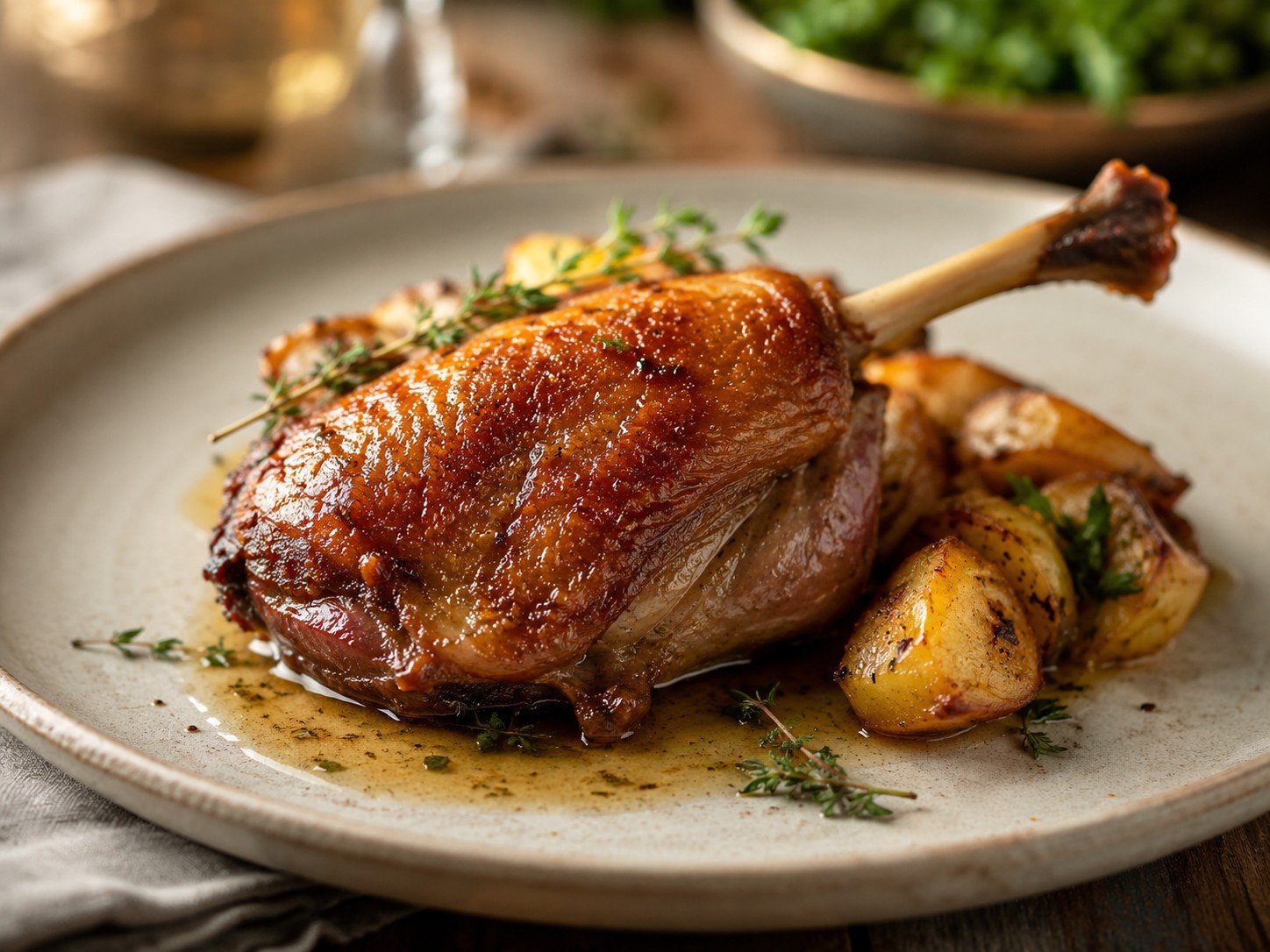
← All RecipesPoultry · FrenchDuck Leg Confit24h cure + 3h cook2 servings680 kcalConfit is one of the oldest preservation techniques in the French culinary repertoire. Long before refrigeration, poultry legs were cured in salt, cooked in their own fat, and sealed away in crocks where they kept for weeks. The process, born of necessity, produces something extraordinary: meat so tender it barely holds itself together, a skin that crisps into something shattering and golden, and a depth of flavor that slow-roasting in dry heat could never replicate.Duck leg confit looks intimidating and is actually almost impossible to get wrong, provided you observe two rules: the salt cure is not optional, and the fat temperature must never boil. Everything else is flexible.Ingredients2 duck legsabout 350g each15g coarse saltper leg4 garlic clovessmashed4 sprigs fresh thyme2 bay leavescrumbled1 tsp black peppercornscracked500-700g duck fatenough to submergeThe science of confitWhen submerged in fat kept below 90°C, the duck legs cook through gentle heat that slowly dissolves collagen into gelatin, making the meat extraordinarily tender. Because the fat temperature never reaches boiling point, moisture loss is minimal. The fat itself does not penetrate the meat significantly. Duck fat is traditional because it has a neutral flavor and high smoke point. Rendered pork lard or goose fat can substitute.The salt cure: 12 to 24 hoursRub each duck leg generously with coarse salt on all surfaces, pressing into the skin and flesh around the bone. Add smashed garlic, thyme, bay leaf, and cracked peppercorns. Place in a container, cover, and refrigerate. The minimum is 12 hours, but 24 hours produces better results. Before cooking, rinse the salt off under cold water. Pat completely dry — surface moisture would lower the fat temperature.Cook at low temperatureMelt duck fat in a deep ovenproof pan over low heat. The fat should never bubble or shimmer visibly. Add the duck legs skin-side up, fully submerged. Target temperature: 82°C to 90°C. The easiest method: 90°C oven (fan) for 3 hours. The legs are done when the meat pulls easily from the bone. Give it another 30 minutes if there is any resistance.Chef note: Confit legs keep submerged in their fat in the refrigerator for up to 3 weeks. Make a large batch, seal with fat on top, and you have exceptional meals waiting. The flavor improves after a few days.The critical final step: crispy skinRemove legs from fat and pat skin completely dry. Heat a heavy skillet over high heat until smoking. Add legs skin-side down with no added fat. Press firmly with a spatula. Cook 4 to 5 minutes without moving until the skin is lacquered golden-brown and crackling. Turn briefly to heat the flesh side, then serve immediately. This final sear is why confit is extraordinary — the contrast between yielding meat and shattering skin is impossible to achieve any other way.ServingClassic accompaniments: Puy lentils with shallots and vinaigrette, sautéed potatoes cooked in the leftover duck fat, or a simple green salad with walnut oil dressing. Save every drop of cooking fat for roasting vegetables or making the best sautéed potatoes of your life.← Back to all recipes="Duck Leg Confit — GetNeatMeat</titlehtml<meta name="description" content="Classic French duck leg confit — salt-cured overnight, slow-cooked submerged in duck fat for 3 hours, then crisped in a screaming-hot pan. The definitive guide to confit de canard."meta<meta name="author" content="GetNeatMeat"meta<meta name="robots" content="index, follow"meta<link rel="canonical" href="https://getneatmeat.com/recipe/duck-leg-confit/"lang="<meta property="og:type" content="article"meta<meta property="og:site_name" content="GetNeatMeat"meta<meta property="og:title" content="Duck Leg Confit — GetNeatMeat"meta<meta property="og:description" content="Classic French duck leg confit — salt-cured overnight, slow-cooked submerged in duck fat for 3 hours, then crisped in a screaming-hot pan. The definitive guide to confit de canard."meta<meta property="og:url" content="https://getneatmeat.com/recipe/duck-leg-confit/"meta<meta property="og:image" content="https://getneatmeat.com/images/duck-leg-confit.jpg"meta<meta name="twitter:card" content="summary_large_image"meta<meta name="twitter:title" content="Duck Leg Confit — GetNeatMeat"meta<meta name="twitter:description" content="Classic French duck leg confit — salt-cured overnight, slow-cooked submerged in duck fat for 3 hours, then crisped in a screaming-hot pan. The definitive guide to confit de canard."meta<meta name="twitter:image" content="https://getneatmeat.com/images/duck-leg-confit.jpg"meta<script type="application/ld+json">{"@context":"https://schema.org","@type":"Recipe","name":"Duck Leg Confit","description":"Classic French duck leg confit","image":["https://getneatmeat.com/images/duck-leg-confit.jpg"],"author":{"@type":"Organization","name":"GetNeatMeat"},"publisher":{"@type":"Organization","name":"GetNeatMeat","url":"https://getneatmeat.com"},"url":"https://getneatmeat.com/recipe/duck-leg-confit/","datePublished":"2026-06-27","prepTime":"PT20M","cookTime":"PT3H","totalTime":"PT27H","recipeYield":"2 servings","recipeCategory":"Main Course","recipeCuisine":"French","keywords":"duck confit, confit de canard, duck leg, French cooking","recipeIngredient":["2 duck legs (about 350g each)","15g coarse salt","4 garlic cloves, smashed","4 sprigs fresh thyme","2 bay leaves, crumbled","1 tsp black peppercorns, cracked","500-700g duck fat"],"recipeInstructions":[{"@type":"HowToStep","name":"Cure","text":"Rub duck legs with salt, garlic, thyme, bay leaf and peppercorns. Refrigerate 12-24 hours."},{"@type":"HowToStep","name":"Cook in fat","text":"Rinse and dry legs. Submerge in duck fat, cook at 90C for 3 hours."},{"@type":"HowToStep","name":"Crisp","text":"Pat dry, place skin-side down in hot dry skillet. Cook 4-5 minutes until skin is golden and crackling."}],"nutrition":{"@type":"NutritionInformation","calories":"680 calories","proteinContent":"42g","fatContent":"55g","carbohydrateContent":"0g"}}</scriptsalt-cured<link rel="preconnect" href="https://fonts.googleapis.com"Leg<link rel="stylesheet" href="https://fonts.googleapis.com/css2?family=Playfair+Display:ital,wght@0,700;0,900;1,700&family=Inter:wght@300;400;500;600&family=DM+Mono:wght@400;500&display=swap"Leg<style>:root{--black:#0a0a0a;--dark:#111111;--dark-2:#1a1a1a;--border:rgba(255,255,255,.08);--border-2:rgba(255,255,255,.14);--ember:#c8502a;--gold:#c9963a;--cream:#f5ede0;--white:#ffffff;--muted:rgba(255,255,255,.45);--muted-2:rgba(255,255,255,.65);--disp:"Playfair Display",Georgia,serif;--body:"Inter",sans-serif;--mono:"DM Mono",monospace;--wrap:1200px;--radius:4px}*,*:before,*:after{margin:0;padding:0;box-sizing:border-box}body{font-family:var(--body);background:var(--black);color:var(--white);font-size:16px;line-height:1.7;-webkit-font-smoothing:antialiased}img{max-width:100%;display:block}a{color:inherit;text-decoration:none}h1,h2,h3{font-family:var(--disp);line-height:1.1}nav{position:fixed;top:0;left:0;right:0;z-index:100;background:#0a0a0ae6;backdrop-filter:blur(12px);border-bottom:1px solid var(--border)}.nav-inner{max-width:var(--wrap);margin:0 auto;padding:0 32px;height:64px;display:flex;align-items:center;gap:48px}.logo{display:flex;align-items:center;gap:10px}.logo-mark{width:32px;height:32px;background:var(--ember);color:#fff;font-family:var(--disp);font-weight:900;font-size:1.1rem;display:flex;align-items:center;justify-content:center;border-radius:2px}.logo-text{font-family:var(--disp);font-weight:700;font-size:1.05rem}.nav-links{display:flex;list-style:none;gap:32px;margin-left:auto}.nav-links a{font-family:var(--mono);font-size:.75rem;text-transform:uppercase;letter-spacing:.12em;color:var(--muted-2)}.nav-cta{font-family:var(--mono);font-size:.72rem;text-transform:uppercase;letter-spacing:.1em;padding:9px 18px;border:1px solid var(--ember);color:var(--ember);border-radius:var(--radius)}@media(max-width:768px){.nav-links,.nav-cta{display:none}}.recipe-hero{position:relative;height:60vh;min-height:400px;display:flex;align-items:flex-end;overflow:hidden}.hero-img{position:absolute;inset:0}.hero-img img{width:100%;height:100%;object-fit:cover}.hero-overlay{position:absolute;inset:0;background:linear-gradient(to top,#0a0a0af2,#0a0a0a4d 60%,#0a0a0a80)}.hero-content{position:relative;z-index:2;max-width:var(--wrap);width:100%;margin:0 auto;padding:100px 32px 48px}.back-link{display:inline-block;font-family:var(--mono);font-size:.72rem;text-transform:uppercase;color:var(--muted-2);margin-bottom:16px}.recipe-cat{display:block;font-family:var(--mono);font-size:.7rem;text-transform:uppercase;color:var(--gold);margin-bottom:12px}h1{font-size:clamp(2rem,5vw,3.8rem);font-weight:900;color:var(--white);line-height:1.05;margin-bottom:20px;max-width:20ch}.meta-pills{display:flex;gap:8px;flex-wrap:wrap}.pill{font-family:var(--mono);font-size:.7rem;text-transform:uppercase;background:#ffffff14;border:1px solid var(--border);color:var(--muted-2);padding:5px 12px;border-radius:2px}.recipe-body{max-width:780px;margin:0 auto;padding:64px 32px 80px}.recipe-content p{color:#fffc;font-size:1.05rem;line-height:1.8;margin-bottom:20px}.recipe-content h2{font-family:var(--disp);font-size:1.5rem;color:var(--cream);font-weight:700;margin:40px 0 16px;padding-top:20px;border-top:1px solid var(--border)}.recipe-content ul{padding-left:24px;margin-bottom:20px}.recipe-content li{color:#ffffffbf;font-size:1rem;line-height:1.7;margin-bottom:8px}.recipe-content strong{color:var(--cream);font-weight:600}.recipe-content em{color:var(--gold);font-style:italic}.recipe-content .ingredients-grid{display:grid;grid-template-columns:repeat(auto-fill,minmax(220px,1fr));gap:12px;margin-bottom:28px}.recipe-content .ingredient-item{background:var(--dark-2);padding:12px 16px;border-radius:var(--radius);border:1px solid var(--border);font-size:.9rem;color:var(--muted-2)}.recipe-content .ingredient-item strong{display:block;color:var(--cream);margin-bottom:2px}.chef-note{background:var(--dark-2);border-left:3px solid var(--gold);padding:16px 20px;margin:28px 0;color:#ffffffbf;font-size:.95rem}.recipe-nav{margin-top:64px;padding-top:32px;border-top:1px solid var(--border)}.btn-back{display:inline-block;font-family:var(--mono);font-size:.75rem;text-transform:uppercase;color:var(--muted-2);border:1px solid var(--border-2);padding:11px 20px;border-radius:var(--radius)}footer{border-top:1px solid var(--border);padding:32px}.footer-inner{max-width:var(--wrap);margin:0 auto;display:flex;align-items:center;justify-content:space-between;flex-wrap:wrap;gap:16px}.footer-logo{display:flex;align-items:center;gap:10px;font-family:var(--disp);font-weight:700}.footer-logo-mark{width:28px;height:28px;background:var(--ember);color:#fff;display:flex;align-items:center;justify-content:center;border-radius:2px}.footer-copy{font-family:var(--mono);font-size:.72rem;color:var(--muted);text-transform:uppercase}</styleswap</head><bodyhours<nav><div class="nav-inner"><a href="/" class="logo"><span class="logo-mark">G</span><span class="logo-text">GetNeatMeat</span></a><ul class="nav-links"><li><a href="/#recipes">Beef</a></li><li><a href="/#recipes">Chicken</a></li><li><a href="/#recipes">Fish</a></li><li><a href="/#recipes">Pork</a></li></ul><a href="/#newsletter" class="nav-cta">Get recipes</a></div></navname<articleauthor <div class="recipe-hero"div <div class="hero-img"><img src="/images/duck-leg-confit.jpg" alt="Duck Leg Confit" width="1200" height="600"><div class="hero-overlay"></div></divdiv <div class="hero-content"divdiv <a href="/" class="back-link">← All Recipes</aalt <span class="recipe-cat">Poultry · French</spansalt-cured <h1>Duck Leg Confit</h1href <div class="meta-pills"><span class="pill">24h cure + 3h cook</span><span class="pill">2 servings</span><span class="pill">680 kcal</span></divDuck </divdivDuck </divdivdivDuck <div class="recipe-body"divdivdivDuck <div class="recipe-content"divdivdivDuck<p>Confit is one of the oldest preservation techniques in the French culinary repertoire. Long before refrigeration, poultry legs were cured in salt, cooked in their own fat, and sealed away in crocks where they kept for weeks. The process, born of necessity, produces something extraordinary: meat so tender it barely holds itself together, a skin that crisps into something shattering and golden, and a depth of flavor that slow-roasting in dry heat could never replicate.</ppill<p>Duck leg confit looks intimidating and is actually almost impossible to get wrong, provided you observe two rules: the salt cure is not optional, and the fat temperature must never boil. Everything else is flexible.</pppill<h2>Ingredients</h2hours<div class="ingredients-grid"Duck<div class="ingredient-item"><strong>2 duck legs</strong>about 350g each</divDuck<div class="ingredient-item"><strong>15g coarse salt</strong>per leg</divdivDuck<div class="ingredient-item"><strong>4 garlic cloves</strong>smashed</divdivdivDuck<div class="ingredient-item"><strong>4 sprigs fresh thyme</strong></divdivdivdivDuck<div class="ingredient-item"><strong>2 bay leaves</strong>crumbled</divdivdivdivdivDuck<div class="ingredient-item"><strong>1 tsp black peppercorns</strong>cracked</divdivdivdivdivdivDuck<div class="ingredient-item"><strong>500-700g duck fat</strong>enough to submerge</divdivdivdivdivdivdivDuck</divdivdivdivdivdivdivdivDuck<h2>The science of confit</h2hours<p>When submerged in fat kept below 90°C, the duck legs cook through gentle heat that slowly dissolves collagen into gelatin, making the meat extraordinarily tender. Because the fat temperature never reaches boiling point, moisture loss is minimal. The fat itself does not penetrate the meat significantly. Duck fat is traditional because it has a neutral flavor and high smoke point. Rendered pork lard or goose fat can substitute.</ppeppercorns<h2>The salt cure: 12 to 24 hours</h2high<p>Rub each duck leg generously with coarse salt on all surfaces, pressing into the skin and flesh around the bone. Add smashed garlic, thyme, bay leaf, and cracked peppercorns. Place in a container, cover, and refrigerate. The minimum is 12 hours, but 24 hours produces better results. Before cooking, rinse the salt off under cold water. Pat completely dry — surface moisture would lower the fat temperature.</pppeppercorns<h2>Cook at low temperature</h2hours<p>Melt duck fat in a deep ovenproof pan over low heat. The fat should never bubble or shimmer visibly. Add the duck legs skin-side up, fully submerged. Target temperature: 82°C to 90°C. The easiest method: 90°C oven (fan) for 3 hours. The legs are done when the meat pulls easily from the bone. Give it another 30 minutes if there is any resistance.</ppppeppercorns<div class="chef-note"><strong>Chef note:</strong> Confit legs keep submerged in their fat in the refrigerator for up to 3 weeks. Make a large batch, seal with fat on top, and you have exceptional meals waiting. The flavor improves after a few days.</divDuck<h2>The critical final step: crispy skin</h2have<p>Remove legs from fat and pat skin completely dry. Heat a heavy skillet over high heat until smoking. Add legs <em>skin-side down</em> with no added fat. Press firmly with a spatula. Cook 4 to 5 minutes without moving until the skin is lacquered golden-brown and crackling. Turn briefly to heat the flesh side, then serve immediately. This final sear is why confit is extraordinary — the contrast between yielding meat and shattering skin is impossible to achieve any other way.</ppan<h2>Serving</h2hours<p>Classic accompaniments: Puy lentils with shallots and vinaigrette, sautéed potatoes cooked in the leftover duck fat, or a simple green salad with walnut oil dressing. Save every drop of cooking fat for roasting vegetables or making the best sautéed potatoes of your life.</pppan </divDuck <div class="recipe-nav"><a href="/" class="btn-back">← Back to all recipes</a></divdivDuck </divdivdivDuck</articleall<footer><div class="footer-inner"><a href="/" class="footer-logo"><span class="footer-logo-mark">G</span><span>GetNeatMeat</span></a><p class="footer-copy">© 2026 GetNeatMeat — All rights reserved</p></div></footerFrench</body></html></head></html>