Gochujang Pork Ribs — GetNeatMeat{"@context":"https://schema.org","@type":"Recipe","name":"Gochujang Pork Ribs","description":"Baby back ribs slow-cooked at low heat, then glazed with gochujang, honey, soy sauce and sesame and broiled until caramelized.","image":["https://getneatmeat.com/images/gochujang-pork-ribs.jpg"],"author":{"@type":"Organization","name":"GetNeatMeat"},"publisher":{"@type":"Organization","name":"GetNeatMeat","url":"https://getneatmeat.com"},"url":"https://getneatmeat.com/recipe/gochujang-pork-ribs/","datePublished":"2026-06-27","prepTime":"PT20M","cookTime":"PT3H","totalTime":"PT3H20M","recipeYield":"4 servings","recipeCategory":"Main Course","recipeCuisine":"Korean-American","keywords":"gochujang ribs, pork ribs, Korean BBQ ribs, baby back ribs","recipeIngredient":["2 racks baby back ribs (about 1.2kg total)","3 tbsp gochujang","2 tbsp honey","2 tbsp soy sauce","1 tbsp sesame oil","1 tbsp rice vinegar","3 garlic cloves, grated","1 tsp grated ginger","1 tbsp toasted sesame seeds","2 spring onions, sliced"],"recipeInstructions":[{"@type":"HowToStep","name":"Prep the ribs","text":"Remove membrane from bone side. Season with salt, pepper, garlic powder. Let sit 30 min."},{"@type":"HowToStep","name":"Slow cook","text":"Wrap tightly in foil. Bake at 150C for 2.5-3 hours until tender but not falling off bone."},{"@type":"HowToStep","name":"Make the glaze","text":"Whisk gochujang, honey, soy sauce, sesame oil, vinegar, garlic, ginger until smooth."},{"@type":"HowToStep","name":"Glaze and broil","text":"Unwrap ribs. Brush generously with glaze. Broil 5-7 min until caramelized. Rest 5 min."}],"nutrition":{"@type":"NutritionInformation","calories":"720 calories","proteinContent":"58g","fatContent":"46g","carbohydrateContent":"18g"}}:root{--black:#0a0a0a;--dark-2:#1a1a1a;--border:rgba(255,255,255,.08);--border-2:rgba(255,255,255,.14);--ember:#c8502a;--gold:#c9963a;--cream:#f5ede0;--white:#ffffff;--muted:rgba(255,255,255,.45);--muted-2:rgba(255,255,255,.65);--disp:"Playfair Display",Georgia,serif;--body:"Inter",sans-serif;--mono:"DM Mono",monospace;--wrap:1200px;--radius:4px}*,*:before,*:after{margin:0;padding:0;box-sizing:border-box}body{font-family:var(--body);background:var(--black);color:var(--white);font-size:16px;line-height:1.7;-webkit-font-smoothing:antialiased}img{max-width:100%;display:block}a{color:inherit;text-decoration:none}h1,h2,h3{font-family:var(--disp);line-height:1.1}nav{position:fixed;top:0;left:0;right:0;z-index:100;background:#0a0a0ae6;backdrop-filter:blur(12px);border-bottom:1px solid var(--border)}.nav-inner{max-width:var(--wrap);margin:0 auto;padding:0 32px;height:64px;display:flex;align-items:center;gap:48px}.logo{display:flex;align-items:center;gap:10px}.logo-mark{width:32px;height:32px;background:var(--ember);color:#fff;font-family:var(--disp);font-weight:900;display:flex;align-items:center;justify-content:center;border-radius:2px}.logo-text{font-family:var(--disp);font-weight:700}.nav-links{display:flex;list-style:none;gap:32px;margin-left:auto}.nav-links a{font-family:var(--mono);font-size:.75rem;text-transform:uppercase;color:var(--muted-2)}.nav-cta{font-family:var(--mono);font-size:.72rem;text-transform:uppercase;padding:9px 18px;border:1px solid var(--ember);color:var(--ember);border-radius:var(--radius)}@media(max-width:768px){.nav-links,.nav-cta{display:none}}.recipe-hero{position:relative;height:60vh;min-height:400px;display:flex;align-items:flex-end;overflow:hidden}.hero-img{position:absolute;inset:0}.hero-img img{width:100%;height:100%;object-fit:cover}.hero-overlay{position:absolute;inset:0;background:linear-gradient(to top,#0a0a0af2,#0a0a0a4d 60%,#0a0a0a80)}.hero-content{position:relative;z-index:2;max-width:var(--wrap);width:100%;margin:0 auto;padding:100px 32px 48px}.back-link{display:inline-block;font-family:var(--mono);font-size:.72rem;text-transform:uppercase;color:var(--muted-2);margin-bottom:16px}.recipe-cat{display:block;font-family:var(--mono);font-size:.7rem;text-transform:uppercase;color:var(--gold);margin-bottom:12px}h1{font-size:clamp(2rem,5vw,3.8rem);font-weight:900;color:var(--white);line-height:1.05;margin-bottom:20px;max-width:20ch}.meta-pills{display:flex;gap:8px;flex-wrap:wrap}.pill{font-family:var(--mono);font-size:.7rem;text-transform:uppercase;background:#ffffff14;border:1px solid var(--border);color:var(--muted-2);padding:5px 12px;border-radius:2px}.recipe-body{max-width:780px;margin:0 auto;padding:64px 32px 80px}.recipe-content p{color:#fffc;font-size:1.05rem;line-height:1.8;margin-bottom:20px}.recipe-content h2{font-family:var(--disp);font-size:1.5rem;color:var(--cream);font-weight:700;margin:40px 0 16px;padding-top:20px;border-top:1px solid var(--border)}.recipe-content .ingredients-grid{display:grid;grid-template-columns:repeat(auto-fill,minmax(220px,1fr));gap:12px;margin-bottom:28px}.recipe-content .ingredient-item{background:var(--dark-2);padding:12px 16px;border-radius:var(--radius);border:1px solid var(--border);font-size:.9rem;color:var(--muted-2)}.recipe-content .ingredient-item strong{display:block;color:var(--cream);margin-bottom:2px}.chef-note{background:var(--dark-2);border-left:3px solid var(--gold);padding:16px 20px;margin:28px 0;color:#ffffffbf;font-size:.95rem}.recipe-nav{margin-top:64px;padding-top:32px;border-top:1px solid var(--border)}.btn-back{display:inline-block;font-family:var(--mono);font-size:.75rem;text-transform:uppercase;color:var(--muted-2);border:1px solid var(--border-2);padding:11px 20px;border-radius:var(--radius)}footer{border-top:1px solid var(--border);padding:32px}.footer-inner{max-width:var(--wrap);margin:0 auto;display:flex;align-items:center;justify-content:space-between;flex-wrap:wrap;gap:16px}.footer-logo{display:flex;align-items:center;gap:10px;font-family:var(--disp);font-weight:700}.footer-logo-mark{width:28px;height:28px;background:var(--ember);color:#fff;display:flex;align-items:center;justify-content:center;border-radius:2px}.footer-copy{font-family:var(--mono);font-size:.72rem;color:var(--muted);text-transform:uppercase}
Gochujang Pork Ribs
← All RecipesPork · Korean

Gochujang Pork Ribs

3h 20min4 servings720 kcal
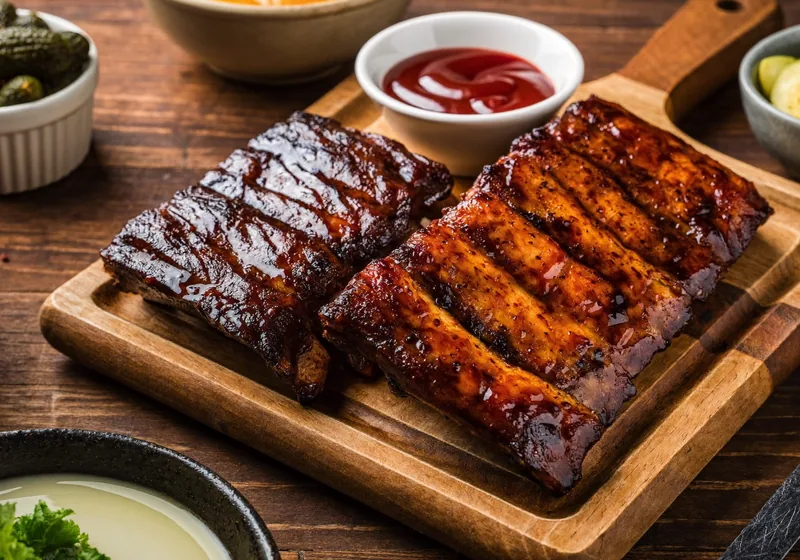
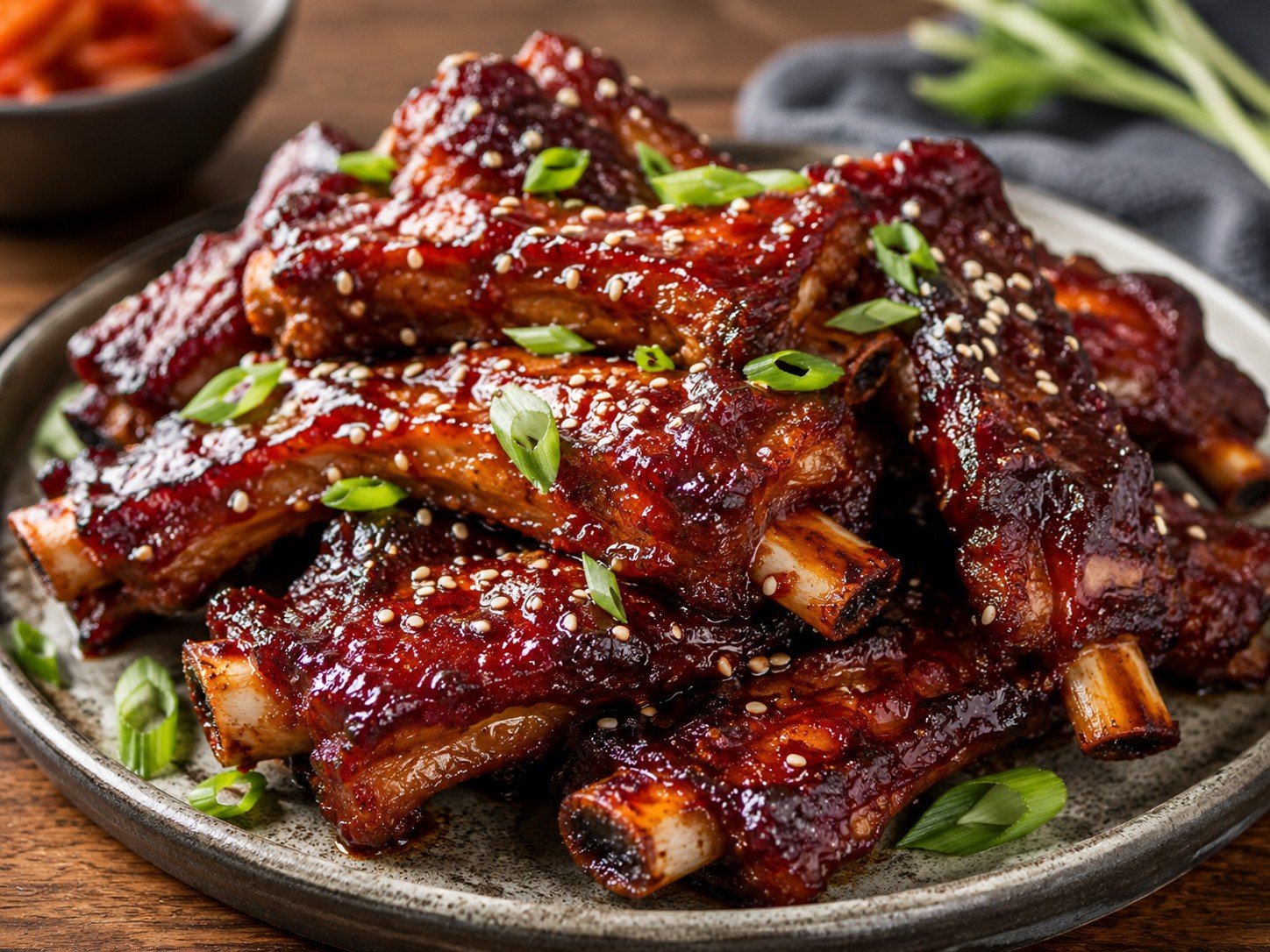
Gochujang is one of those ingredients that changes everything it touches. The fermented Korean red chile paste — made from chiles, glutinous rice, fermented soybeans, and salt, aged in clay pots — has a flavor that is simultaneously spicy, sweet, earthy, and deeply funky. It caramelizes under heat in a way that no other chile product does. Applied to pork ribs, it creates a lacquered, mahogany crust that is hard to stop eating.This recipe uses a two-stage approach: slow-cook the ribs wrapped in foil until they are tender and the connective tissue has fully dissolved, then unwrap and glaze them under a broiler at high heat. The foil stage is about tenderness. The broiler stage is about flavor — the glaze caramelizes, chars at the edges, and concentrates into something glossy and addictive.The ribs2 racks baby back ribsabout 1.2kg totalSalt and black pepper1 tsp garlic powderThe gochujang glaze3 tbsp gochujangKorean fermented chile paste2 tbsp honey2 tbsp soy sauce1 tbsp sesame oiltoasted1 tbsp rice vinegar3 garlic clovesgrated on a microplane1 tsp fresh gingergratedTo finish1 tbsp sesame seedstoasted2 spring onionsthinly slicedPrepare the ribsThe membrane on the bone side of the rack must come off. Slide a knife under the edge of the membrane, grab it with a paper towel (it is slippery), and pull firmly. It will peel away in one sheet. Leaving it on creates a chewy, impenetrable barrier that prevents seasoning from penetrating the meat from below and produces an unpleasant texture in the final dish.Season both sides of each rack generously with salt, black pepper, and garlic powder. Let the racks sit at room temperature for 30 minutes. This is enough time for the salt to begin drawing moisture to the surface and then reabsorbing it back into the meat with the seasoning dissolved in it — a short brine effect.The slow cookPreheat the oven to 150°C. Wrap each rack tightly in two layers of aluminum foil — a tight seal is critical. Any gap will allow steam to escape, drying the ribs out and slowing the tenderizing process. Place the wrapped racks on a baking sheet and cook for 2.5 to 3 hours.The target is ribs that are tender and yielding when you press them through the foil, but where the meat has not started to fall off the bone. Ribs that fall off the bone before the broiler stage will disintegrate under the glaze. You want structure. The collagen should have converted to gelatin — when you open the foil, you will see a pool of rendered fat and deeply colored juices. These juices can be added to the glaze for extra depth.The glazeWhisk together the gochujang, honey, soy sauce, sesame oil, rice vinegar, grated garlic, and ginger until completely smooth. Taste it: it should be aggressively seasoned, fiery, and sweet. It will mellow on the ribs. If you want more heat, add another tablespoon of gochujang. If you want more sweetness, add another teaspoon of honey.Chef note: Not all gochujang is the same. The thick, dark paste in 500g tubs from Korean grocery stores is different from the milder, thinner versions in Western supermarkets. The traditional thick paste is what you want: it clings to the ribs and caramelizes properly. The thinner supermarket versions tend to run off and burn.Glaze and broilTurn the oven to broil (high). Unwrap the ribs and transfer to a foil-lined baking sheet. Brush generously with glaze on the top side. Broil for 5 to 7 minutes until the glaze is bubbling and caramelized with dark char at the edges. Pull out, brush with a second coat of glaze, and return for another 3 minutes. Watch carefully — gochujang burns fast under direct heat.Rest for 5 minutes before cutting between the bones. Serve with toasted sesame seeds, sliced spring onions, and steamed rice. The juices that collect on the baking sheet after broiling can be drizzled over the cut ribs as a finishing sauce.Make-aheadThe slow-cook stage can be done a day in advance. Keep the ribs wrapped in foil in the refrigerator after cooking. When ready to serve, bring to room temperature for 30 minutes, then broil with the glaze. This actually improves the result: the overnight rest firms up the meat slightly, giving the ribs more structure for the broiling stage.="Gochujang Pork Ribs — GetNeatMeat</titlehtml<meta name="description" content="Gochujang pork ribs: baby back ribs slow-cooked then glazed in a fermented Korean chile paste with honey, sesame and soy. Sticky, smoky, fiery."meta<meta name="author" content="GetNeatMeat"><meta name="robots" content="index, follow"meta<link rel="canonical" href="https://getneatmeat.com/recipe/gochujang-pork-ribs/"lang="<meta property="og:type" content="article"><meta property="og:title" content="Gochujang Pork Ribs — GetNeatMeat"meta<meta property="og:description" content="Baby back ribs glazed in gochujang, honey and sesame. Slow-cooked then broiled to caramelized perfection."meta<meta property="og:url" content="https://getneatmeat.com/recipe/gochujang-pork-ribs/"meta<meta property="og:image" content="https://getneatmeat.com/images/gochujang-pork-ribs.jpg"meta<meta name="twitter:card" content="summary_large_image"meta<meta name="twitter:image" content="https://getneatmeat.com/images/gochujang-pork-ribs.jpg"meta<script type="application/ld+json">{"@context":"https://schema.org","@type":"Recipe","name":"Gochujang Pork Ribs","description":"Baby back ribs slow-cooked at low heat, then glazed with gochujang, honey, soy sauce and sesame and broiled until caramelized.","image":["https://getneatmeat.com/images/gochujang-pork-ribs.jpg"],"author":{"@type":"Organization","name":"GetNeatMeat"},"publisher":{"@type":"Organization","name":"GetNeatMeat","url":"https://getneatmeat.com"},"url":"https://getneatmeat.com/recipe/gochujang-pork-ribs/","datePublished":"2026-06-27","prepTime":"PT20M","cookTime":"PT3H","totalTime":"PT3H20M","recipeYield":"4 servings","recipeCategory":"Main Course","recipeCuisine":"Korean-American","keywords":"gochujang ribs, pork ribs, Korean BBQ ribs, baby back ribs","recipeIngredient":["2 racks baby back ribs (about 1.2kg total)","3 tbsp gochujang","2 tbsp honey","2 tbsp soy sauce","1 tbsp sesame oil","1 tbsp rice vinegar","3 garlic cloves, grated","1 tsp grated ginger","1 tbsp toasted sesame seeds","2 spring onions, sliced"],"recipeInstructions":[{"@type":"HowToStep","name":"Prep the ribs","text":"Remove membrane from bone side. Season with salt, pepper, garlic powder. Let sit 30 min."},{"@type":"HowToStep","name":"Slow cook","text":"Wrap tightly in foil. Bake at 150C for 2.5-3 hours until tender but not falling off bone."},{"@type":"HowToStep","name":"Make the glaze","text":"Whisk gochujang, honey, soy sauce, sesame oil, vinegar, garlic, ginger until smooth."},{"@type":"HowToStep","name":"Glaze and broil","text":"Unwrap ribs. Brush generously with glaze. Broil 5-7 min until caramelized. Rest 5 min."}],"nutrition":{"@type":"NutritionInformation","calories":"720 calories","proteinContent":"58g","fatContent":"46g","carbohydrateContent":"18g"}}</scriptsummary_large_image<link rel="stylesheet" href="https://fonts.googleapis.com/css2?family=Playfair+Display:ital,wght@0,700;0,900;1,700&family=Inter:wght@300;400;500;600&family=DM+Mono:wght@400;500&display=swap"link<style>:root{--black:#0a0a0a;--dark-2:#1a1a1a;--border:rgba(255,255,255,.08);--border-2:rgba(255,255,255,.14);--ember:#c8502a;--gold:#c9963a;--cream:#f5ede0;--white:#ffffff;--muted:rgba(255,255,255,.45);--muted-2:rgba(255,255,255,.65);--disp:"Playfair Display",Georgia,serif;--body:"Inter",sans-serif;--mono:"DM Mono",monospace;--wrap:1200px;--radius:4px}*,*:before,*:after{margin:0;padding:0;box-sizing:border-box}body{font-family:var(--body);background:var(--black);color:var(--white);font-size:16px;line-height:1.7;-webkit-font-smoothing:antialiased}img{max-width:100%;display:block}a{color:inherit;text-decoration:none}h1,h2,h3{font-family:var(--disp);line-height:1.1}nav{position:fixed;top:0;left:0;right:0;z-index:100;background:#0a0a0ae6;backdrop-filter:blur(12px);border-bottom:1px solid var(--border)}.nav-inner{max-width:var(--wrap);margin:0 auto;padding:0 32px;height:64px;display:flex;align-items:center;gap:48px}.logo{display:flex;align-items:center;gap:10px}.logo-mark{width:32px;height:32px;background:var(--ember);color:#fff;font-family:var(--disp);font-weight:900;display:flex;align-items:center;justify-content:center;border-radius:2px}.logo-text{font-family:var(--disp);font-weight:700}.nav-links{display:flex;list-style:none;gap:32px;margin-left:auto}.nav-links a{font-family:var(--mono);font-size:.75rem;text-transform:uppercase;color:var(--muted-2)}.nav-cta{font-family:var(--mono);font-size:.72rem;text-transform:uppercase;padding:9px 18px;border:1px solid var(--ember);color:var(--ember);border-radius:var(--radius)}@media(max-width:768px){.nav-links,.nav-cta{display:none}}.recipe-hero{position:relative;height:60vh;min-height:400px;display:flex;align-items:flex-end;overflow:hidden}.hero-img{position:absolute;inset:0}.hero-img img{width:100%;height:100%;object-fit:cover}.hero-overlay{position:absolute;inset:0;background:linear-gradient(to top,#0a0a0af2,#0a0a0a4d 60%,#0a0a0a80)}.hero-content{position:relative;z-index:2;max-width:var(--wrap);width:100%;margin:0 auto;padding:100px 32px 48px}.back-link{display:inline-block;font-family:var(--mono);font-size:.72rem;text-transform:uppercase;color:var(--muted-2);margin-bottom:16px}.recipe-cat{display:block;font-family:var(--mono);font-size:.7rem;text-transform:uppercase;color:var(--gold);margin-bottom:12px}h1{font-size:clamp(2rem,5vw,3.8rem);font-weight:900;color:var(--white);line-height:1.05;margin-bottom:20px;max-width:20ch}.meta-pills{display:flex;gap:8px;flex-wrap:wrap}.pill{font-family:var(--mono);font-size:.7rem;text-transform:uppercase;background:#ffffff14;border:1px solid var(--border);color:var(--muted-2);padding:5px 12px;border-radius:2px}.recipe-body{max-width:780px;margin:0 auto;padding:64px 32px 80px}.recipe-content p{color:#fffc;font-size:1.05rem;line-height:1.8;margin-bottom:20px}.recipe-content h2{font-family:var(--disp);font-size:1.5rem;color:var(--cream);font-weight:700;margin:40px 0 16px;padding-top:20px;border-top:1px solid var(--border)}.recipe-content .ingredients-grid{display:grid;grid-template-columns:repeat(auto-fill,minmax(220px,1fr));gap:12px;margin-bottom:28px}.recipe-content .ingredient-item{background:var(--dark-2);padding:12px 16px;border-radius:var(--radius);border:1px solid var(--border);font-size:.9rem;color:var(--muted-2)}.recipe-content .ingredient-item strong{display:block;color:var(--cream);margin-bottom:2px}.chef-note{background:var(--dark-2);border-left:3px solid var(--gold);padding:16px 20px;margin:28px 0;color:#ffffffbf;font-size:.95rem}.recipe-nav{margin-top:64px;padding-top:32px;border-top:1px solid var(--border)}.btn-back{display:inline-block;font-family:var(--mono);font-size:.75rem;text-transform:uppercase;color:var(--muted-2);border:1px solid var(--border-2);padding:11px 20px;border-radius:var(--radius)}footer{border-top:1px solid var(--border);padding:32px}.footer-inner{max-width:var(--wrap);margin:0 auto;display:flex;align-items:center;justify-content:space-between;flex-wrap:wrap;gap:16px}.footer-logo{display:flex;align-items:center;gap:10px;font-family:var(--disp);font-weight:700}.footer-logo-mark{width:28px;height:28px;background:var(--ember);color:#fff;display:flex;align-items:center;justify-content:center;border-radius:2px}.footer-copy{font-family:var(--mono);font-size:.72rem;color:var(--muted);text-transform:uppercase}</styleswap</head><bodyheight<nav><div class="nav-inner"><a href="/" class="logo"><span class="logo-mark">G</span><span class="logo-text">GetNeatMeat</span></a><ul class="nav-links"><li><a href="/#recipes">Beef</a></li><li><a href="/#recipes">Chicken</a></li><li><a href="/#recipes">Fish</a></li><li><a href="/#recipes">Pork</a></li></ul><a href="/#newsletter" class="nav-cta">Get recipes</a></div></navname<articleand<div class="recipe-hero"><div class="hero-img"><img src="/images/gochujang-pork-ribs.jpg" alt="Gochujang Pork Ribs" width="1200" height="600"><div class="hero-overlay"></div></div><div class="hero-content"><a href="/" class="back-link">← All Recipes</a><span class="recipe-cat">Pork · Korean</span><h1>Gochujang Pork Ribs</h1><div class="meta-pills"><span class="pill">3h 20min</span><span class="pill">4 servings</span><span class="pill">720 kcal</span></div></div></divdiv<div class="recipe-body"><div class="recipe-content"divdiv<p>Gochujang is one of those ingredients that changes everything it touches. The fermented Korean red chile paste — made from chiles, glutinous rice, fermented soybeans, and salt, aged in clay pots — has a flavor that is simultaneously spicy, sweet, earthy, and deeply funky. It caramelizes under heat in a way that no other chile product does. Applied to pork ribs, it creates a lacquered, mahogany crust that is hard to stop eating.</pPork<p>This recipe uses a two-stage approach: slow-cook the ribs wrapped in foil until they are tender and the connective tissue has fully dissolved, then unwrap and glaze them under a broiler at high heat. The foil stage is about tenderness. The broiler stage is about flavor — the glaze caramelizes, chars at the edges, and concentrates into something glossy and addictive.</ppPork<h2>The ribs</h2heat<div class="ingredients-grid"description<div class="ingredient-item"><strong>2 racks baby back ribs</strong>about 1.2kg total</divdescription<div class="ingredient-item"><strong>Salt and black pepper</strong></divdivdescription<div class="ingredient-item"><strong>1 tsp garlic powder</strong></divdivdivdescription</divdivdivdivdescription<h2>The gochujang glaze</h2honey<div class="ingredients-grid"divdivdivdivdescription<div class="ingredient-item"><strong>3 tbsp gochujang</strong>Korean fermented chile paste</divdivdivdivdivdescription<div class="ingredient-item"><strong>2 tbsp honey</strong></divdivdivdivdivdivdescription<div class="ingredient-item"><strong>2 tbsp soy sauce</strong></divdivdivdivdivdivdivdescription<div class="ingredient-item"><strong>1 tbsp sesame oil</strong>toasted</divdivdivdivdivdivdivdivdescription<div class="ingredient-item"><strong>1 tbsp rice vinegar</strong></divdivdivdivdivdivdivdivdivdescription<div class="ingredient-item"><strong>3 garlic cloves</strong>grated on a microplane</divdivdivdivdivdivdivdivdivdivdescription<div class="ingredient-item"><strong>1 tsp fresh ginger</strong>grated</divdivdivdivdivdivdivdivdivdivdivdescription</divdivdivdivdivdivdivdivdivdivdivdivdescription<h2>To finish</h2honey<div class="ingredients-grid"divdivdivdivdivdivdivdivdivdivdivdivdescription<div class="ingredient-item"><strong>1 tbsp sesame seeds</strong>toasted</divdivdivdivdivdivdivdivdivdivdivdivdivdescription<div class="ingredient-item"><strong>2 spring onions</strong>thinly sliced</divdivdivdivdivdivdivdivdivdivdivdivdivdivdescription</divdivdivdivdivdivdivdivdivdivdivdivdivdivdivdescription<h2>Prepare the ribs</h2h2honey<p>The membrane on the bone side of the rack must come off. Slide a knife under the edge of the membrane, grab it with a paper towel (it is slippery), and pull firmly. It will peel away in one sheet. Leaving it on creates a chewy, impenetrable barrier that prevents seasoning from penetrating the meat from below and produces an unpleasant texture in the final dish.</pPork<p>Season both sides of each rack generously with salt, black pepper, and garlic powder. Let the racks sit at room temperature for 30 minutes. This is enough time for the salt to begin drawing moisture to the surface and then reabsorbing it back into the meat with the seasoning dissolved in it — a short brine effect.</ppPork<h2>The slow cook</h2honey<p>Preheat the oven to 150°C. Wrap each rack tightly in two layers of aluminum foil — a tight seal is critical. Any gap will allow steam to escape, drying the ribs out and slowing the tenderizing process. Place the wrapped racks on a baking sheet and cook for 2.5 to 3 hours.</pPork<p>The target is ribs that are tender and yielding when you press them through the foil, but where the meat has not started to fall off the bone. Ribs that fall off the bone before the broiler stage will disintegrate under the glaze. You want structure. The collagen should have converted to gelatin — when you open the foil, you will see a pool of rendered fat and deeply colored juices. These juices can be added to the glaze for extra depth.</ppPork<h2>The glaze</h2honey<p>Whisk together the gochujang, honey, soy sauce, sesame oil, rice vinegar, grated garlic, and ginger until completely smooth. Taste it: it should be aggressively seasoned, fiery, and sweet. It will mellow on the ribs. If you want more heat, add another tablespoon of gochujang. If you want more sweetness, add another teaspoon of honey.</pPork<div class="chef-note"><strong>Chef note:</strong> Not all gochujang is the same. The thick, dark paste in 500g tubs from Korean grocery stores is different from the milder, thinner versions in Western supermarkets. The traditional thick paste is what you want: it clings to the ribs and caramelizes properly. The thinner supermarket versions tend to run off and burn.</divdescription<h2>Glaze and broil</h2honey<p>Turn the oven to broil (high). Unwrap the ribs and transfer to a foil-lined baking sheet. Brush generously with glaze on the top side. Broil for 5 to 7 minutes until the glaze is bubbling and caramelized with dark char at the edges. Pull out, brush with a second coat of glaze, and return for another 3 minutes. Watch carefully — gochujang burns fast under direct heat.</pPork<p>Rest for 5 minutes before cutting between the bones. Serve with toasted sesame seeds, sliced spring onions, and steamed rice. The juices that collect on the baking sheet after broiling can be drizzled over the cut ribs as a finishing sauce.</ppPork<h2>Make-ahead</h2honey<p>The slow-cook stage can be done a day in advance. Keep the ribs wrapped in foil in the refrigerator after cooking. When ready to serve, bring to room temperature for 30 minutes, then broil with the glaze. This actually improves the result: the overnight rest firms up the meat slightly, giving the ribs more structure for the broiling stage.</pPork</div><div class="recipe-nav"><a href="/" class="btn-back">← Back to all recipes</a></div></divdescription</articleall<footer><div class="footer-inner"><a href="/" class="footer-logo"><span class="footer-logo-mark">G</span><span>GetNeatMeat</span></a><p class="footer-copy">© 2026 GetNeatMeat — All rights reserved</p></div></footerfor</body></html></head></html>